Cirque of Salazie
The greenest of the three cirques, accessible in 45 minutes from Saint-André, featuring Hell-Bourg with its créole houses and the Voile de la Mariée waterfall cascade.
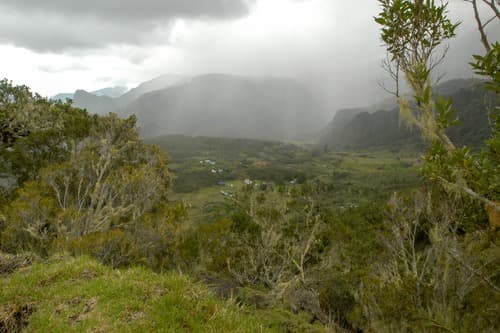
Salazie is the wettest and most verdant of the three cirques on the island. Nestled northeast of Piton des Neiges, it opens via a single road that climbs the Rivière du Mât from Saint-André, on the windward coast. In 45 minutes of winding curves, you pass from coastal sugarcane fields to an amphitheater of cliffs clad in primary forest, where rain falls up to 26 feet per year in the depths. It is this water that defines Salazie: it feeds the waterfalls that tumble continuously from the cliffs, irrigates the crops, and maintains the deep green hue that distinguishes the cirque from its more mineral neighbors, Mafate and Cilaos.
The village of Hell-Bourg, at 3,100 feet elevation, structures life in the cirque. Once a 19th-century thermal spa abandoned after the bath collapse in 1948, the village has preserved a rare concentration of créole houses with covered galleries, fretwork trim, and tropical flower gardens. It has been classified among France's Most Beautiful Villages since 1990. Maison Folio, open for tours, offers a clear picture of 19th-century créole bourgeois living: rooms in succession, tamarind parquet floors, and a créole garden organized by purpose (medicinal, ornamental, vegetable). Lower down, Salazie-village and Mare à Vieille Place retain a more rural character, oriented toward agriculture.
This agriculture centers on chayote, which Réunionnese farmers cultivate on trellises for kilometers along the roads of the cirque. You'll find it in gratins, stews, preserves, pickles, and even as brèdes (tender shoots sautéed with garlic). Salazie is its historical cradle on the island, so much so that locals speak of the "chayote country." The Chayote Festival takes place each year in May in Hell-Bourg: farmers' markets, cooking demonstrations, séga and maloya in the evening. On the table, you'll also find palmiste, duck with vanilla, and guava preserves that grow wild above 3,300 feet.
The cirque takes its name from a runaway slave, Salazie, who took refuge here in the 18th century. Like Mafate and Cilaos, Salazie was first a maroon territory before being colonized by "small whites from the highlands" in the 19th century. This history is legible in the place names: Îlet à Vidot, Mare à Poule d'Eau, Grand Îlet—hamlets founded by families who cleared the plateaus at the foot of the cliffs. Grand Îlet, to the west of the cirque, remains the most populated and provides access to Bœufs Pass, the classic starting point for reaching Mafate on foot.
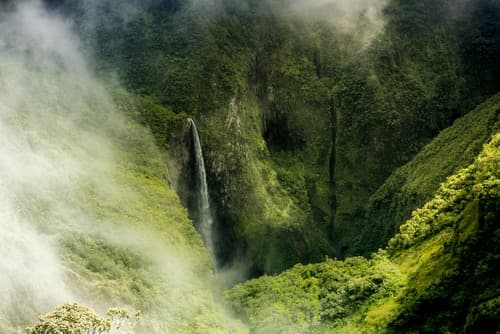
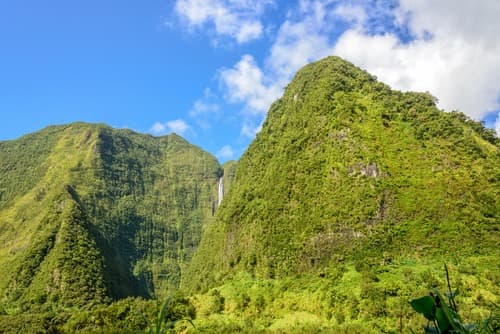
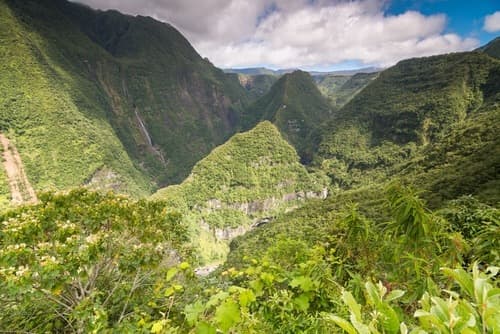
As for landscapes, two sites command attention. The Voile de la Mariée (Bridal Veil), visible from the main road, is a succession of waterfalls cascading in threads over 1,000 feet: it flows year-round, more spectacular after the rains of January to March. The Trou de Fer (Iron Hole), a 1,000-foot-deep chasm into which the Rivière du Mât plunges in several falls, is reached from the Bélouve lodge after 6 hours of round-trip hiking on wooden boardwalks through the tamarind forest of the highlands. The final viewpoint overlooks a closed rocky cirque, often veiled by clouds rising from the cirque mid-day: we recommend starting early, around 6am, to have a genuine chance of seeing the depths.
Of the three cirques, Salazie is the most accessible by car and best suited to a short stay or a traveler who doesn't want to hike for several days. It's also the easiest entry point to Mafate via Bœufs Pass, making it a useful logistical base for combining the two cirques.
To discover
Hell-Bourg and Maison Folio. Wander the streets of this classified village, among créole houses with covered galleries and begonia gardens. Maison Folio, open for guided tours, tells the story of 19th-century créole living.
The Trou de Fer viewpoint. Six hours of hiking from the Bélouve lodge, largely on wooden boardwalks through the tamarind forest, to reach the viewpoint that plunges over a 1,000-foot chasm.
The Voile de la Mariée waterfall. Directly visible from the road between Salazie-village and Hell-Bourg, it cascades in several threads over 1,000 feet of cliff face and flows year-round, intensified after rains.
Chayote country. Crops on trellises along the roads, markets in Salazie and Hell-Bourg, farm tables where you taste chayote in gratins, stews, and preserves. Chayote Festival in May.
Bœufs Pass toward Mafate. Above Grand Îlet, the Bœufs Pass parking (6,400 feet) marks the classic starting point for making your way on foot to the hamlets of Mafate, 2 to 3 hours' hike depending on your destination.
When to visit
Salazie is the wettest region on the island, with up to 26 feet of cumulative rain per year in the depths. The dry season, from May to October, remains most comfortable: daytime temperatures of 64 to 75°F in Hell-Bourg, cool nights around 54°F, and clear visibility in the morning before clouds rise from the cirque around 11am or noon. July and August can drop to 46°F at night at altitude—bring a fleece.
From December to March, it's austral summer and cyclone season: precipitation is heavy, trails may close after rainy episodes, and clouds frequently obscure viewpoints from 9am onward. The waterfalls, however, reach peak flow, making the road to Hell-Bourg particularly spectacular. We avoid scheduling long hikes (Trou de Fer, traverse to Mafate) between January and March unless the weather window is confirmed the day before.
Practical tips
Plan 2 full days to explore Salazie well: one day for Hell-Bourg, Maison Folio, and the Voile de la Mariée waterfall, a second for the Trou de Fer hike from Bélouve. With 3 days, add Grand Îlet and a relaxed day at a farm table. Access is by road from Saint-André on the east coast, 45 minutes of winding curves: there is no other road entry to the cirque. Roland-Garros Airport (Saint-Denis) is roughly 1 hour away by car.
Salazie logically combines with Mafate cirque, accessible on foot from Bœufs Pass above Grand Îlet, and with the east coast and Piton de la Fournaise to complete an eastern loop of the island. Comfort is that of the créole guesthouse, often in a renovated house with dinner provided: family-friendly, well-maintained, without great luxury. The region suits travelers who enjoy hiking a few hours a day, families with children from age 8 onward, and contemplatives drawn to créole architecture and verdant landscapes. Seasoned hikers use it as a gateway before spending several days in Mafate.