Cirque de Mafate
A cirque with no roads, accessible only on foot or by helicopter, where eight inhabited islets live by the rhythm of mountain trails and helicopter supply runs.
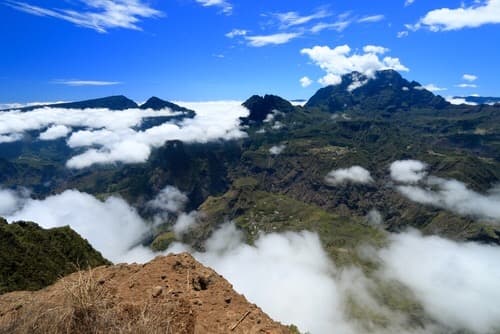
Mafate is not an ordinary valley. This 100 km² cirque formed by the collapse of Piton des Neiges roughly two million years ago, and its tortured landscape of vertical ramparts, narrow ridges and deep ravines has discouraged any road construction. Entry is only on foot via the GR R2 and GR R3 trails, or by helicopter from Saint-Pierre's heliport or the Pierrefonds base. No cars, no paved roads: it is the only French municipality in this situation.
Eight inhabited islets share the cirque, perched between 900 and 1,500 metres altitude. La Nouvelle, at 1,421 metres, serves as the unofficial capital with around forty gîtes and a primary school. Marla, further south, is the highest village. Roche Plate, Îlet à Bourse, Aurère, Grand Place, Îlet à Malheur and Cayenne complete the map. All are resupplied by helicopter two to three times per week, which explains the cost of accommodation in gîtes and the inevitably local cuisine: grains (Cilaos lentils, red beans), chicken curry, spiced sausage, locally grown chaya leaf dishes.
The inhabitants, roughly 800 in total, are largely descended from the "poor whites of the highlands" and the Maroons—enslaved people who fled the coastal plantations in the 18th century to take refuge in these inaccessible cirques. Place names bear the trace of this history: the Anchaing peak is named after a Maroon leader, Mafate itself is said to derive from a fugitive healer's name. This memory remains alive in the stories shared at the gîte each evening, over a rum punch infused with lychee or calamansi.
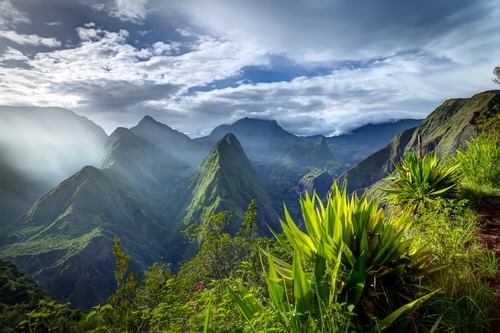
The landscape shifts hourly. At dawn around 6am, slanting light illuminates the ramparts of Maïdo (2,205 m) to the west and Roche Écrite (2,277 m) to the north, still dry. By 10-11am, the trade winds push clouds against the walls and the cirque fills with mist until evening. This daily cycle dictates walking schedules: departure from the gîte at 5:30am, arrival at the next lodge before 1pm. The trails traverse forests of tamarind, tree ferns, bamboo, and sometimes exposed passages equipped with chains like the Bronchard ascent or the descent into the Bras des Merles ravine.
Economically, Mafate lives from trekking tourism. Around fifty labelled gîtes, a dozen small shops, a few porters and muleteers. No bank, no pharmacy, limited mobile coverage except at La Nouvelle and the Bœufs pass. This simplicity is not stage dressing: it is the reality of a territory that has chosen to remain without roads, despite several road-building projects abandoned since the 1970s.
To understand Mafate, you must accept walking. A traverse from east to west, from the Bœufs pass to Maïdo, requires a minimum of four days with daily elevation gains of 800 to 1,200 metres. The views from the Taïbit pass (2,081 m) over Cilaos and from the Saint-Paul breach over the west coast justify the effort, provided you reach the summit before clouds roll in.
Must-see
Traverse from Bœufs pass to Maïdo. Four to five days trekking from east to west, with nights at La Nouvelle, Roche Plate and Marla. Departure is from the Bœufs pass parking area at 1,950 metres; arrival at the Maïdo viewpoint offers a sweeping view over the entire cirque.
Night in a gîte at La Nouvelle. Shared meal at the dinner table around 7pm: chicken curry, grains, rice, tomato relish. Gîtes close at 9pm, silence returns and you hear tenrecs rustling in the brush around wooden houses with corrugated roofs.
Scout Trail towards Aurère. One of the most exposed passages in the cirque, cut into the cliff above the Galets river. Chains and metal steps over 200 metres of elevation, best traversed in the morning before mist obscures the anchors.
Trois Roches and Malheur basin. On the trail between Marla and Roche Plate, these basalt slabs carved with petroglyphs attributed to Maroons overlook a waterfall. You can swim between stages; the water stays 16-18°C even in warm season.
Helicopter flight from Saint-Pierre. Flight lasting 25 to 45 minutes over the three cirques. Useful to grasp the overall geography before or after a trek, or to reach an islet without trekking in.
When to go
The dry season runs from April to November, with particularly stable weather from June to September. Temperatures at 1,400 metres range from 8°C at night to 22°C during the day, and trails are passable. July-August can drop below 5°C at Marla at dawn; bring a fleece and hat for pre-dawn departures. Morning visibility is excellent until around 10-11am, then trade-wind clouds rise up the ramparts.
From December to March, cyclone season brings intense rainfall: 200 to 400 mm can fall in 24 hours during an active episode, making certain ravines impassable for several days and sometimes causing trail washouts. We advise against long traverses during this period. January and February are months to avoid for Mafate, except for short gîte stays with schedule flexibility.
Practical advice
Plan for a minimum of four days for a proper traverse, five to six for a comfortable loop taking in two or three islets. Three days suffice for a short loop like Bœufs pass - La Nouvelle - Marla - return, manageable for a regular walker in good condition. Logistical entry is from Saint-Denis (Roland Garros airport), with two hours' drive to either the Bœufs pass or Maïdo depending on your chosen direction. We arrange bag portage by muleteer or helicopter on request for trekkers who prefer to travel light.
Mafate naturally combines with the Cilaos cirque, accessible from Marla via the Taïbit pass in one day, or with Salazie via the Bœufs pass. Many of our clients chain Mafate with an ascent of Piton de la Fournaise to contrast the mineral world of the volcano with the cirque's forests, then finish with a few days on the west coast between Saint-Gilles and Saint-Leu for rest and the lagoon. Gîte comfort remains rustic but clean: dormitories of 4 to 8 beds, hot showers most of the time, generous meals. Mafate suits independent trekkers and contemplative travellers who accept the physical demands, less so families with children under 10 or travellers seeking hotel comfort.